
PMI Calculator
Estimate your monthly Private Mortgage Insurance cost, check your Loan-to-Value ratio, and find out how much you need to pay down to remove PMI.
PMI drops when LTV ≤ 80%. Auto-cancelled at 78%.
PMI Removal Calculator
Already paying PMI? Enter your home value and current loan balance to see your LTV and how much you need to pay down to reach 80% and request cancellation.
Planning a lump-sum payment? See how it also lowers your monthly payment with our Mortgage Recast Calculator.
What is Private Mortgage Insurance (PMI)?
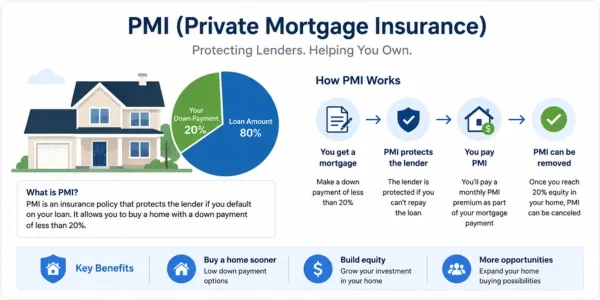
Private Mortgage Insurance (PMI) protects lenders when a borrower makes a down payment of less than 20% on a home loan. PMI is commonly required on conventional mortgage loans with a high loan-to-value ratio (LTV). Most lenders charge between 0.3% and 1.5% of the loan amount per year.
PMI Calculation Formula
LTV Ratio = Loan Amount ÷ Home Price × 100
Annual PMI = Loan Amount × PMI Rate (%)
Monthly PMI = Annual PMI ÷ 12
How to Calculate PMI on a Mortgage
- Determine the home purchase price.
- Subtract the down payment to find the loan amount.
- Divide the loan amount by the home price to find the LTV ratio.
- If LTV exceeds 80%, multiply the loan amount by the PMI rate.
- Divide the yearly PMI cost by 12 for the monthly amount.
PMI Cost Examples by Loan Size
| Home Price | Down Payment | Loan Amount | PMI Rate | Monthly PMI |
|---|---|---|---|---|
| $300,000 | $30,000 (10%) | $270,000 | 0.5% | $112.50 |
| $400,000 | $40,000 (10%) | $360,000 | 0.7% | $210.00 |
| $500,000 | $50,000 (10%) | $450,000 | 0.8% | $300.00 |
| $600,000 | $90,000 (15%) | $510,000 | 0.6% | $255.00 |
When is PMI Required?
PMI is required when the LTV ratio exceeds 80% — meaning the down payment is less than 20% of the purchase price. The higher the LTV, the higher the PMI rate typically applied.
How Long Will You Pay PMI?
On a conventional loan, PMI does not last forever. You can ask your lender to cancel it once your balance is scheduled to reach 80% of the home's original value, and under the Homeowners Protection Act it must end automatically when the balance is scheduled to reach 78%, as long as your payments are current. Enter your interest rate in the calculator above to see both dates for your loan.
Example: on a $300,000 home with 10% down ($270,000 loan) at 6.5% for 30 years, the principal-and-interest payment is about $1,707. At a 0.5% PMI rate you would pay about $112.50 a month in PMI. With normal payments, the balance reaches 80% of the original value after about 7 years and 11 months, and PMI ends automatically after about 9 years and 1 month, for roughly $12,300 of PMI in total. Extra principal payments or a lump sum shorten that timeline.
What Affects Your PMI Rate?
- Down payment / LTV: the smaller your down payment, the higher the rate.
- Credit score: borrowers with higher scores usually get noticeably lower PMI rates.
- Debt-to-income ratio: a higher DTI can mean a higher premium.
- Loan type and term: adjustable-rate loans and some loan programs can cost more to insure.
Your lender's Loan Estimate shows your actual PMI cost, so use the rate from it once you have one.
PMI vs. FHA Mortgage Insurance
PMI applies to conventional loans. FHA loans use a different system called mortgage insurance premium (MIP): an upfront premium plus an annual premium. Unlike PMI, FHA annual MIP generally lasts 11 years if you put down at least 10%, and for the life of the loan if you put down less, unless you refinance into a conventional loan. That difference is one reason borrowers with good credit often compare a conventional loan with PMI against an FHA loan before choosing.
How to Remove PMI
- Reach 20% equity — request cancellation from your lender.
- Make extra principal payments to hit 80% LTV faster.
- Get a new home appraisal if market values have risen.
- Refinance the mortgage when your equity is sufficient.
- At 78% LTV, lenders are legally required to cancel PMI automatically.
Use the PMI Removal Calculator above to find exactly how much you need to pay down to eliminate PMI. If you plan to make a lump-sum payment, our Mortgage Recast Calculator can show how that lowers your monthly payment.